The DfE has launched the high needs place change process for 2027 to 2028. Local authorities use it to tell DfE how many high needs places they will fund at each academy, free school and college in
their area. Place numbers should reflect local special educational needs and disabilities and alternative provision reform plans.
The process covers:
-
Academies and free schools with SEN units, resourced provision or
sixth forms
-
special and AP academies
-
special free schools from their second year
-
urther education colleges and independent learning providers
Maintained schools are out of scope unless they convert to academy status by 1 January 2027. If your school isn't listed in the outcomes, your 2026 to 2027 numbers roll forward.
From the start of the 2026 to 2027 academic year, all children from households receiving Universal Credit are entitled to a free school meal. Families must apply to receive this support. Universal infant free school meals (UIFSM) continue to be available
to all children in reception, year 1 and year 2, including those who are not eligible for benefits-based FSM. Transitional protections ended at the end of the 2025 to 2026 academic year. Schools and local authorities must now assess eligibility using a household’s current circumstances
Targeted and expanded free school meals.
There are 2 categories of benefits-based free school meals.
-
Targeted free school meals apply to children who meet the criteria used before the expansion. These pupils receive a free meal and may qualify for other education entitlements and funding.
-
Expanded free school meals apply to children from households receiving Universal Credit who do not meet the targeted criteria. These pupils are entitled to a free meal only.
Actions for schools and local authorities:
-
Raise awareness and support applications
-
-
Check eligibility. Recheck eligibility for FSM pupils from before 2026-2027.
-
Record eligibility accurately. Record each eligible pupil’s FSM category as targeted or expanded in the autumn school census by 2 November 2026.
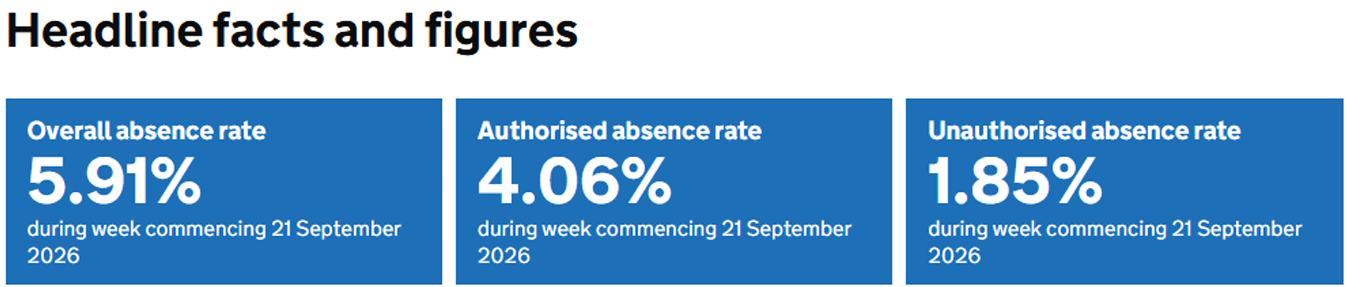
This release covers the 2026/27 academic year up to 25 September 2026. The attendance rate (proportion of possible sessions attended) was 94.09% across all schools in the week commencing 21 September 2026. The absence rate was, therefore, 5.91% across all schools.
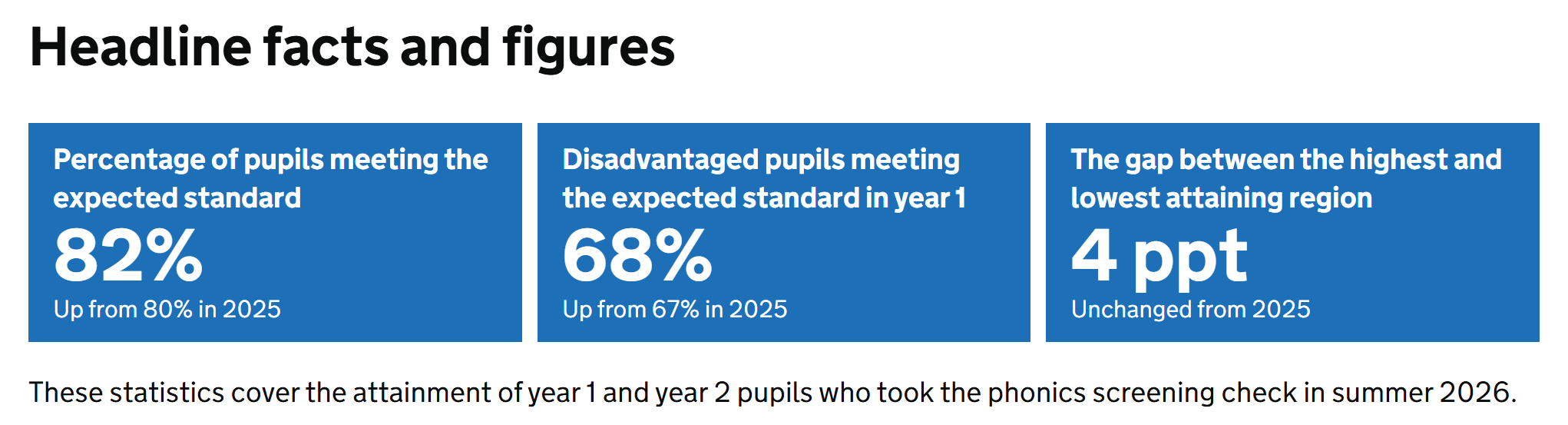
Attainment in the phonics screening check has increased compared to 2025.
82% of pupils met the expected standard in the phonics screening check in year 1, up from 80% in 2025.
89% of pupils met the expected standard by the end of year 2, unchanged from 2025.
Disadvantaged pupils performed less well than other pupils, and the gap has remained similar to 2025 (17 percentage points). 68% of disadvantaged pupils met the expected standard in year 1, up from 67% in 2025.
London is the highest performing region, where 84% of pupils met the expected standard in year 1; the lowest performing regions were the North East and North West with 80%. The gap between the highest and lowest attaining region is 4 percentage points.